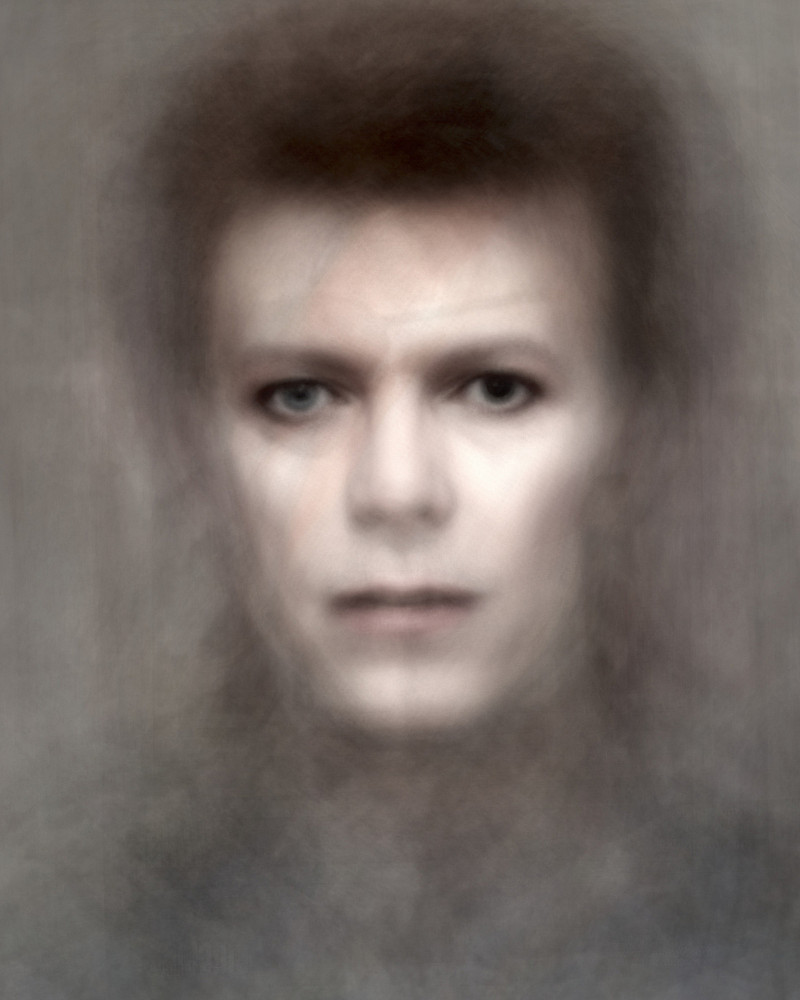
- Ziggy to Blackstar: He Never Sat for This Portrait CD jewel-case edition
- ANDRE CLEMENTS
- layered-averaging composite print
He never sat for this portrait.
What you see is a frontal face held in grey mist, the hair dissolving at its edges into a halo of other haircuts, the eyes not quite matching (each one weighted a fraction off from the other, a ghost of his asymmetry surviving the average). The mouth is closed. The hold is direct. Ziggy, the Thin White Duke, Aladdin Sane, Major Tom, Halloween Jack, Blackstar: none of them is centred, and all of them are here. Three hundred and nineteen photographs, each held at equal 1/319 weight, aligned on eye midpoint and mouth and averaged in perceptually uniform colour space. No single image wins. What emerges is a figure that none of them alone contains: Bowie as a sum of how he has been pictured. This is via parametric authorship: a rule-set declared, a source-stock selected, the software executing what the rule-set demands. The ethical position sits in the 1/N — no source dominates, no persona crowned over the others. Ziggy is not elevated above Blackstar; neither is elevated above a passport-photograph moment between records. A small piece of code does the pressing, which is arguably the least interesting sentence in this paragraph. What matters more is the compression itself, and what survived it: the quiet. Bowie is the exemplary subject for this method. A man who refused fixity first, who killed Ziggy on stage in 1973 and kept moving, whose constant reinvention means the source stock spans an extraordinary range of visual identities. Averaging is a machine for finding what remains when every version is given the same room. With Bowie the machine finds a face you feel you recognise but that never existed — a holographic character, the version that was always underneath the versions. The two works hold the same image at two scales, and the relation between them is the relation the work is already about. Three hundred and nineteen into one, for the large print. One into ten, for the edition. Many into one, one into many. It is posture as much as aesthetic, something kinda queer, kinda kinky, kinda cute among the versions of a man who was never only one thing. And yet the face looks back in a way that always seems to be folding something. It never existed, and it returns a look anyway, which is, kind of, what a tribute is for. It’s also kind of alien, isn’t it, a man recognisably shining across time, like a star, man. References Clements, A.S. (2026) tools/layer-average.py. Layered-averaging pipeline built in Python 3 using OpenCV, MediaPipe FaceLandmarker and NumPy. Source and documentation: ArtPraxis repository, tools/. Methodology notes: studio/layered-averaging-methodology.md. Lineage: continuous with the Composers I–V series (2012, Resolution Gallery), Bridge (Phase 6 — Sheep may safely graze) (2012), and the bodyTime() double-exposure life- drawing series (2017–). The equal-weighting constraint runs through all of them; the software is new, the ethic is not. Source photographs: three hundred and nineteen images of David Bowie harvested via tools/harvest-commons.py and tools/harvest-images.py from publicly available archives, spanning Ziggy Stardust through Blackstar. Full attribution manifest maintained at exhibitions/2026-bowie-tribute/sources/manifest.csv. Exhibition curated by Gordon Froud for The Viewing Room Art Gallery at St. Lorient, Pretoria (23 May – 15 June 2026).
Medium: layered-averaging composite print (unique, 570 mm at 300 DPI) + CD jewel case edition of 10 (12×12 cm) Tools: layer-average.py; 319 source photographs Lineage: continuous with Composers I–V (2012) and bodyTime() (2017–)
