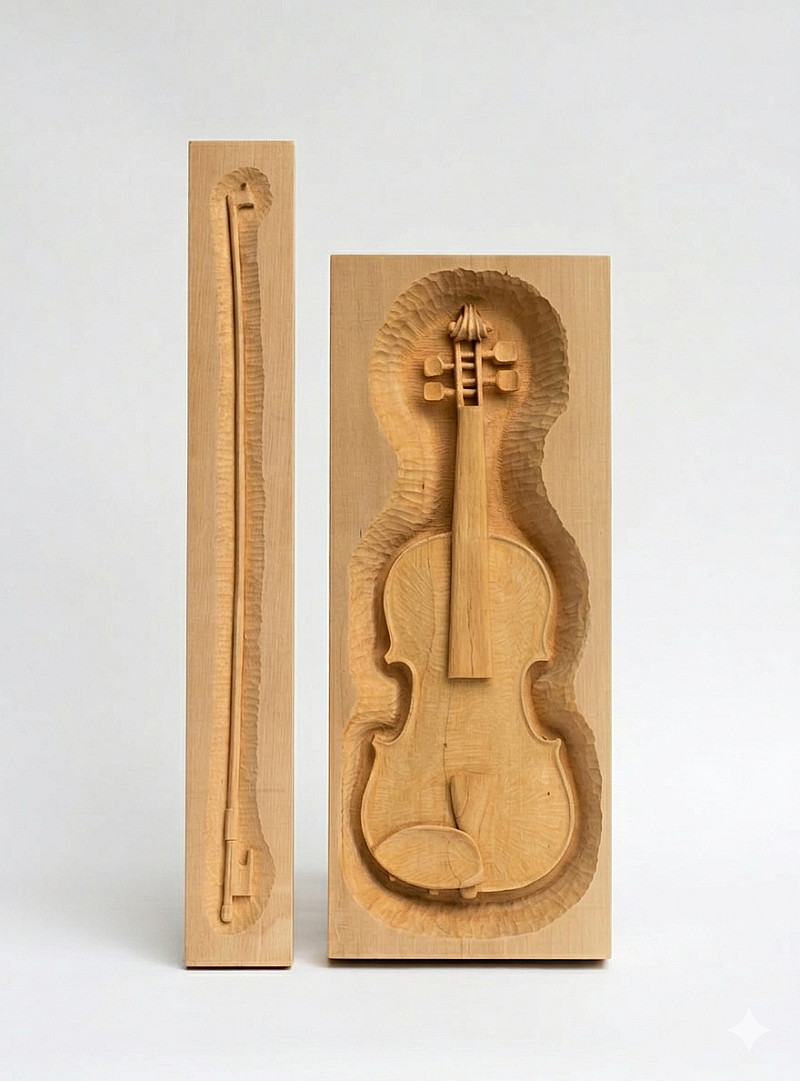
- Bow
- Reinhard Giezing
- Jelutong
- 1 of 1
- 83 x 10.5 x 2 centimeters
1. A short concept statement
The violin needs no introduction. To look at it is to know what it sounds like. To almost audibly hear the tenderness emotion and power it is capable of. There is a beautiful relationship between violin and bow.
They once spoke in a language no one could see.
The violin carried a voice deep in its hollow body, warm and waiting, and the bow knew exactly how to wake it. When the bow moved across the strings, the violin answered without hesitation. Together they breathed emotion into the air — sometimes soft as a whisper, sometimes trembling with longing, sometimes full of joy.
They understood one another.
The bow knew the curve of the violin’s body, and the violin knew the careful weight of the bow’s touch. Between them lived a delicate tension — the pull of strings stretched just enough to carry feeling from one to the other. In the small space where bow met string, something larger than either of them was born.
Music.
For years they moved together like this, inseparable in purpose. The bow would travel and return, and each time the violin would answer, its voice rising from wood and air as if it had been waiting all along. They were two bodies with a single breath.
But one day the strings were gone.
Without them, the bow could no longer reach the violin in the way it once had. The fragile bridge between them had vanished. And so they were placed apart, each held in its own block of wood. Their familiar shapes remain, preserved in stillness, the path between them, quiet.
They can still see one another. They remember the weight of touch, the tension of the strings, the way the smallest movement between them could fill a room with sound.
The music is gone, but something remains.
Somewhere in the still space between them, the memory of that music still lingers — like an echo waiting patiently to be heard again.
